Frame number, motor, battery, display Check e-bikes, pedelecs and bicycles before you buy
Type in the number the seller gives you, or the one you can read off the bike: the frame number, motor number, battery number or display number. We compare it with the GLOBALBACK Cloud and show you straight away whether anything has been reported for that number. Free of charge, no sign-up.
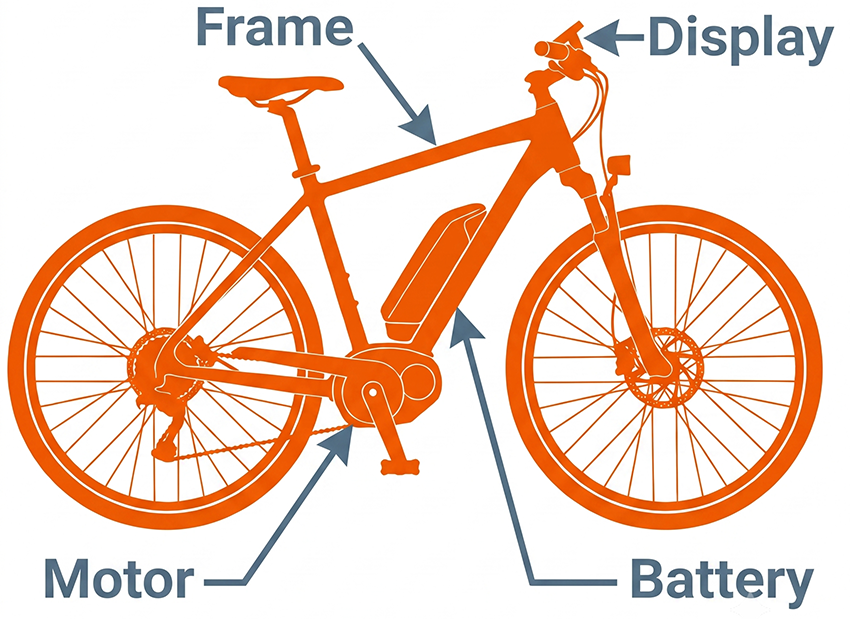
The frame number is usually stamped underneath the bottom bracket, sometimes on the seat tube or on the rear dropout. Motor, battery and display numbers are printed on the part itself – on many modern e-bikes they can also be shown directly on the display or in the manufacturer's app.
Why one minute of checking pays off
A stolen e-bike, pedelec or bicycle costs you twice
A bargain that turns out to be stolen property is not a bargain. You lose the bike – and usually your money too.
Buying in good faith is no guarantee
The rules differ widely from one country to the next. In many European legal systems the owner of a stolen item can demand it back – even from someone who had no idea when they bought it. Sometimes only within a time limit, sometimes only against reimbursement of the purchase price.
In theory you then claim your money back from the seller. In practice, sellers of this kind are rarely findable afterwards. Check what applies where you live.
When handling stolen goods comes into play
Buying something you know – or accept as likely – to come from a crime is a criminal offence in every European country. Someone who genuinely had no idea is not automatically guilty.
It gets difficult with the classic warning signs: a strikingly low price, no receipt, a frame number that has been filed off, a seller who does not know their own bike. Buy anyway and “I had no idea” becomes hard to argue.
No buyers, no market
Bikes get stolen because they can be sold on. The harder the resale, the less attractive the business.
That is not a statistic, just a simple thought – and the reason we ask everyone to check before buying and to walk away from a warning hit.
Being honest about it
What the result tells you – and what it does not
After you enter a number, a coloured card appears. Here is what the colours mean, so you can read the result correctly.
Red: warning status
The owner has marked the item as stolen, lost or not for sale. Do not buy it. You can contact the owner straight from the card; for “stolen”, the police reference number is shown as well if one was entered.
Red: linked component
The number you entered looks fine, but another part of the same bike carries a warning status – a clean frame with a motor reported as stolen, for example. This is exactly why it is worth recording every number.
Amber: entry found, status “for sale”
There is an entry for this number and the owner has released it for sale. This is not a certificate of clean origin: still check the paperwork, the seller's ID and whether the story adds up.
Grey: no entry
The number has not been reported to us. That does not mean the bike is clean – it only means nobody has entered it here. The vast majority of bicycles are not registered anywhere.
Orange: technical error
The database could not be reached for a moment. Please try again in a few minutes – and do not treat this message as a result.
Several hits
Serial numbers are not unique worldwide. If entries from different manufacturers exist for one number, we show them all – so check the manufacturer and model.
What this check cannot do
We only see what owners have entered themselves. A bike that was never registered will not show up here even after it is stolen. And we cannot rule out that someone enters a bike that is not theirs and marks it as “for sale”.
A result without a warning is therefore no substitute for common sense: ask for the purchase receipt, note the seller's name and address, and be suspicious of prices that are too good to be true.
Figures, not gut feeling
How big the problem really is
Bicycle theft is not a marginal issue but a mass offence – and most people who lose a bike never see it again.
Sources: Eurostat, police-recorded offences in the EU, 2024 data. European Cyclists’ Federation (ECF), analysis paper on bicycle theft, June 2023, based on 2020–2022 data. Not every EU country records bicycle theft separately – the European bicycle figures are therefore approximations, not official EU statistics.
Every unchecked purchase keeps the cycle running. Every refusal makes it a little less profitable.
Numbers within reach
The numbers only help if you actually have them when it matters
Before a stolen bike – or a display, a battery, a motor sold on separately – can be recognised as stolen, somebody has to be able to state the number. The police when you report it, the lost property office when they try to match it, the careful buyer when they check. Nobody knows those numbers by heart.
And that moment rarely happens at your own desk, where the receipt sits in a folder. It happens at the station, on a campsite, on holiday – and there you are in front of a foreign police officer, asked for a fourteen-character frame number.
Record once, available anywhere
In the GLOBALBACK Cloud you store the frame, motor, battery and display numbers together with make and model. You can call them up from any device with an internet connection – including the hotel wi-fi.
You sign in with a one-time link sent by e-mail, no password needed. There is no app; the site runs in the browser. For travelling there is a print view you can print out or save.
One click instead of hunting for paperwork
If the bike is gone, you set the status to STOLEN or LOST – for the whole bike or just for the part that is missing. With “stolen” you can add the police reference number.
From that moment on, every GLOBALBACK check portal shows a warning when someone enters the number. And anyone who finds the bike or is offered it can – if you wish – call you directly or reach you through a contact form.
And the GBID on top
GLOBALBACK is not only the database behind this page, it also issues the GBID: a short number, unique worldwide, that you attach visibly to the bike, the battery or the display – engraved, printed, as a sticker or as a QR code.
A finder then has nothing to search for: they read the GBID or scan the QR code and can tell you about the find straight away. Your e-mail address stays hidden from them.
So that nothing is misunderstood here
An entry with GLOBALBACK is not an official registration and not a link to police databases. It does not replace reporting a theft to the police – it makes sure that you have the numbers and that anyone checking the number sees your report.
Where can I register a stolen e-bike, pedelec or bicycle?
You can register a stolen e-bike, pedelec or bicycle with GLOBALBACK free of charge. Immediately after registration, the entry can be looked up here and on other websites! We recommend not waiting until a theft happens, but registering right after you buy.
Four numbers instead of one – while the paperwork is still in front of you
The best moment to register is the day you get the bike. The invoice and handover documents are on the table, the battery is not fitted yet, the display is still clean. Later on, nobody collects these numbers voluntarily – and after a theft it is too late.
- An e-bike is made up of several valuable parts. With GLOBALBACK you record the frame number and also the numbers of the motor, battery and display/control unit – each with its own manufacturer, model and status.
- Register your bike as NOT FOR SALE. The cloud then states permanently: this bike is not up for sale. If it is stolen and somebody checks the number, a red warning card appears immediately – even if you have not noticed the theft yet.
- One click changes the status. Selling the bike? Set it to FOR SALE and the buyer sees an entry instead of a warning. Stolen or lost? Switch to STOLEN or LOST. For “stolen” you can add the police reference number.
- Hand it over properly. The ownership transfer moves the entry to the buyer – including single components, if you only sell the battery or the motor.
Example: one pedelec in the cloud
Illustration only. The frame number is required; motor, battery and display are optional – but they are exactly the parts that get sold separately.
The other case
Many bikes are not sold on – they are simply dumped
Not every theft is a business. Some bikes are used for a single ride and then left somewhere: at the station, in a hedge, on a street corner. If someone finds them and hands them in, they end up at the lost property office.
If nobody claims them within a certain period, they are auctioned off or scrapped. The problem is rarely the finder – it is identification: with no readable number and no entry anywhere, nobody knows who the bike belongs to.
If you have registered your identification numbers, your chances are noticeably better. Better still if you have also attached a GBID with the GLOBALBACK address visibly to the bike: then nobody has to search, they only have to read.
What a GBID is
This is where the GBID comes in – the GLOBALBACK identification number. It is a number that is unique worldwide, which you obtain from GLOBALBACK and attach to your property yourself: engraved, printed, as a sticker or as a QR code. It is short, easy to read and sits where people can actually see it – unlike the frame number, hidden under the bottom bracket in the dirt.
If someone finds your bike, they do not have to know anything or look for anyone. If the GBID is attached as a QR code, one scan with a phone is enough: the finder sees the contact options straight away – a contact form and, if you have stored one, your phone number for finders. Nothing to type in, nothing to copy down. Without a QR code they enter the GBID at globalback.com and reach the same result, it just takes a few seconds longer. Your e-mail address stays hidden from them either way.
And because the same number covers everything that matters to you, it also marks your keys, your luggage or your camera. One number – not a new one for every item. You create the matching QR code at GLOBALBACK yourself.
What the GBID is not
It is not a tracker, not a GPS device, not theft protection in the sense of a lock. The GBID helps at the moment when an honest person is standing in front of your bike wondering who owns it.
You still need a good lock. As a rule of thumb, experts suggest spending five to ten per cent of the price of the bike on a solid folding, chain or U-lock.
Two ways
Report free of charge – or take the full package
Reporting a lost or stolen bike costs nothing. If you want to protect your bike in advance and manage several items, you need a GBID.
Free, without a GBID
Report a loss or theft
€0 · all you need is an e-mail address
- exactly one item per account
- status STOLEN or LOST
- appears immediately on every GLOBALBACK check portal
- finders and buyers can reach you through a contact form – and, if you wish, by phone as well: you decide whether your number is shown publicly with a check result, and you can switch it off again at any time
The full package
With a GLOBALBACK ID (GBID)
€10.95 per GBID for 3 years · three for €21.90 · GLOBALBACK Cloud included
All prices are final prices.
- register as many items as you own privately – not just one
- every status, including NOT FOR SALE for the time before a theft
- all components per bike: frame, motor, battery, control unit
- ownership transfer when selling, print view, phone number for finders
- the GBID itself: one number for everything that matters to you – not just the bike, valid for three years
- intended for private use; businesses, clubs and companies receive an individual offer on request – an e-mail to email@globalback.de is enough
Insuring is not the same as preventing
We get worked up about theft figures. Then we take out insurance and consider the matter settled. It is not: insurance replaces your bike, it prevents not a single theft. The damage has not gone away, it has only been passed on.
And it comes back. The higher the claims, the higher the premiums – paid by everyone who is insured. Anyone who eventually will not or cannot pay is left with no cover at all.
Prevention, by contrast, costs almost nothing: record the numbers of frame, motor, battery and display once, while the invoice and papers are still in front of you. After that they are there when you need them – including far from home. If you take your bike on holiday and lose it there, you will be standing in front of a foreign police officer being asked for exactly those numbers. In the GLOBALBACK Cloud you have them with you, available from any device with an internet connection.
The tool is there, access costs nothing, registering takes a minute. Using it is up to each of us.
Frequently asked
Short answers
Where do I find the frame number on my bicycle or e-bike?
In most cases it is stamped into the frame underneath the bottom bracket, where the cranks sit. Other common places are the seat tube, the rear dropout or the area around the head tube. For e-bikes and pedelecs it is often printed on the purchase receipt or the dealer's handover document as well.
Where do I find the motor, battery and display number?
These numbers are printed or engraved on the part itself – on the motor housing, on the underside of the battery, on the back of the control unit. On many modern e-bikes they can also be shown directly on the display or in the manufacturer's app, without unscrewing anything. They are often listed on the purchase receipt or the dealer's handover document as well.
What does a check on EBIKE-CHECK.online cost?
Nothing. Checking a number is free and needs no sign-up. You do not have to create an account or enter an e-mail address.
My bike has been stolen – what should I do?
Report it to the police first; have the frame number, purchase receipt, make, colour and photos ready. After that you can enter the bike in the GLOBALBACK Cloud as stolen, free of charge. It then appears on every GLOBALBACK check portal, and anyone checking the number sees a warning and can – if you wish – call you directly or reach you through a contact form. You can add the police reference number too.
Does “no entry found” mean the bike is clean?
No. It only means that nothing has been reported for this number in the GLOBALBACK Cloud. The vast majority of bicycles are not registered anywhere, and a thief will hardly register their loot. So check the purchase receipt, the seller's ID and whether the price makes sense.
Do I need a GBID to register my bike?
Not to report it as stolen or lost – that is free with a guest account, but limited to exactly one item. If you want to register your bike as a precaution, manage several items or use the status NOT FOR SALE, you need a GBID. One costs €10.95 for three years, three cost €21.90, and the GLOBALBACK Cloud is included.
Perhaps you have already noticed something pleasant:
you did not have to dismiss a cookie banner here.
Why not? Because we really are a service made by users for users, and not merely pretending to be. We do without unsustainable advertising promises entirely – even though that has become almost unusual on today’s internet.
Privacy is a valuable thing. That is why we do not scrutinise you, do not build user profiles and do not sell your data – nor do we analyse it for advertising.
To register with GLOBALBACK, your e-mail address is all we need – for guest registrations, a telephone number as well. You do not have to remember a new password or disclose personal address details. Our own access logs serve solely to protect against misuse – they delete themselves after 30 days at the latest.
This is what honest, transparent protection looks like.
We would be delighted if you value this approach, use our service and recommend us to others.